Exponential Prelude for piano trio and Live Electronics, 8’
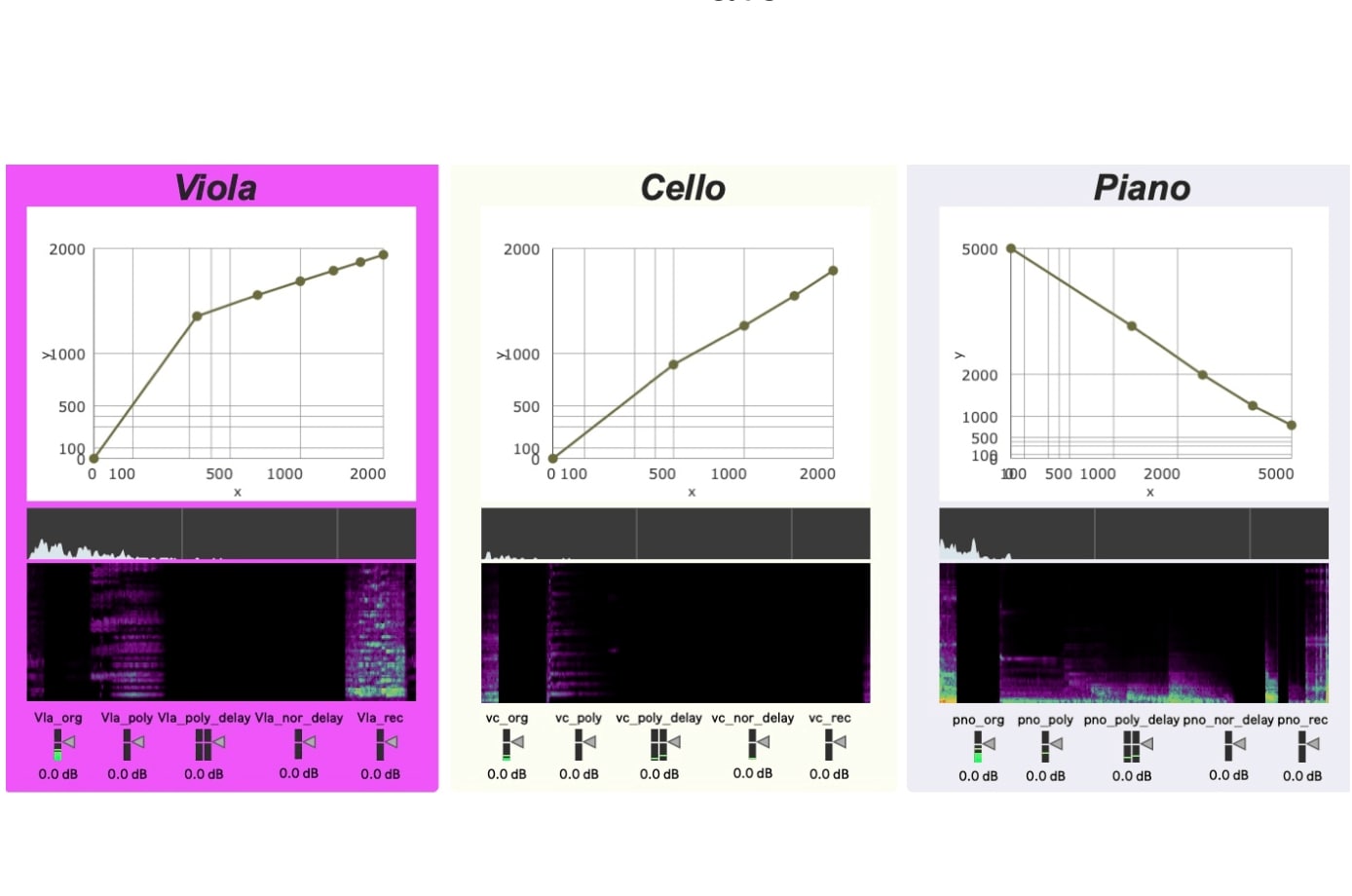
Exponential Prelude for piano trio and live electronics is a piece conceived from the properties of time found in gradual and curving functions that appear in exponential functions. The piece that starts slow does not speed up linearly, but curves like an exponential function. The viola and cello build up like artificial overtones from the low notes of the piano, and are subdivided rhythmically. The electronic sounds that respond to the sound of each instrument in the trio take time and slope as parameters having various graph shapes, and the ratio of various points is obtained according to the nums dividing the octave into halves in the exponential function. It gets the rhythm and pitch from the graph and adds it to the actual live sound source, dealing with the subtle sounds.
These pitches create an artificial harmonics series through specific points derived from parameters, and the electronic sounds that gradually appear in proportion to the slope of the exponential function, such as the overtone gradually appearing from the base, as in the meaning of the overtone. Gradually, it reacts immediately to the sound of live instruments without delay, and accordingly, artificial harmonic sequences are combined with the sound of real instruments to become a single timbre. The rhythm gradually becomes denser and the tempo faster, as if reminiscent of the exponential function becoming denser. And the relatively consonant parts of the piece that appear in the middle of the composition of the piece evoke these artificial harmonics as a natural harmonic sequence. It means to be, and these characteristics make it possible to recall the state of mathematical alignment and misalignment.
It is rather more natural for living things to be curved, like the change in the cycle of time when a creature's running gradually stops, rather than a symmetrical and straight line. This piece was made that way.
* The italic font indicates the parameter values of Max so that they can be
checked.
* The attached simulation sound source was not properly applied with various techniques, including
extended techniques, due to the limitations extracted from the program MIDI sound source, and all
electronic sounds of this piece are not the same as those of the actual performance for the above reasons.